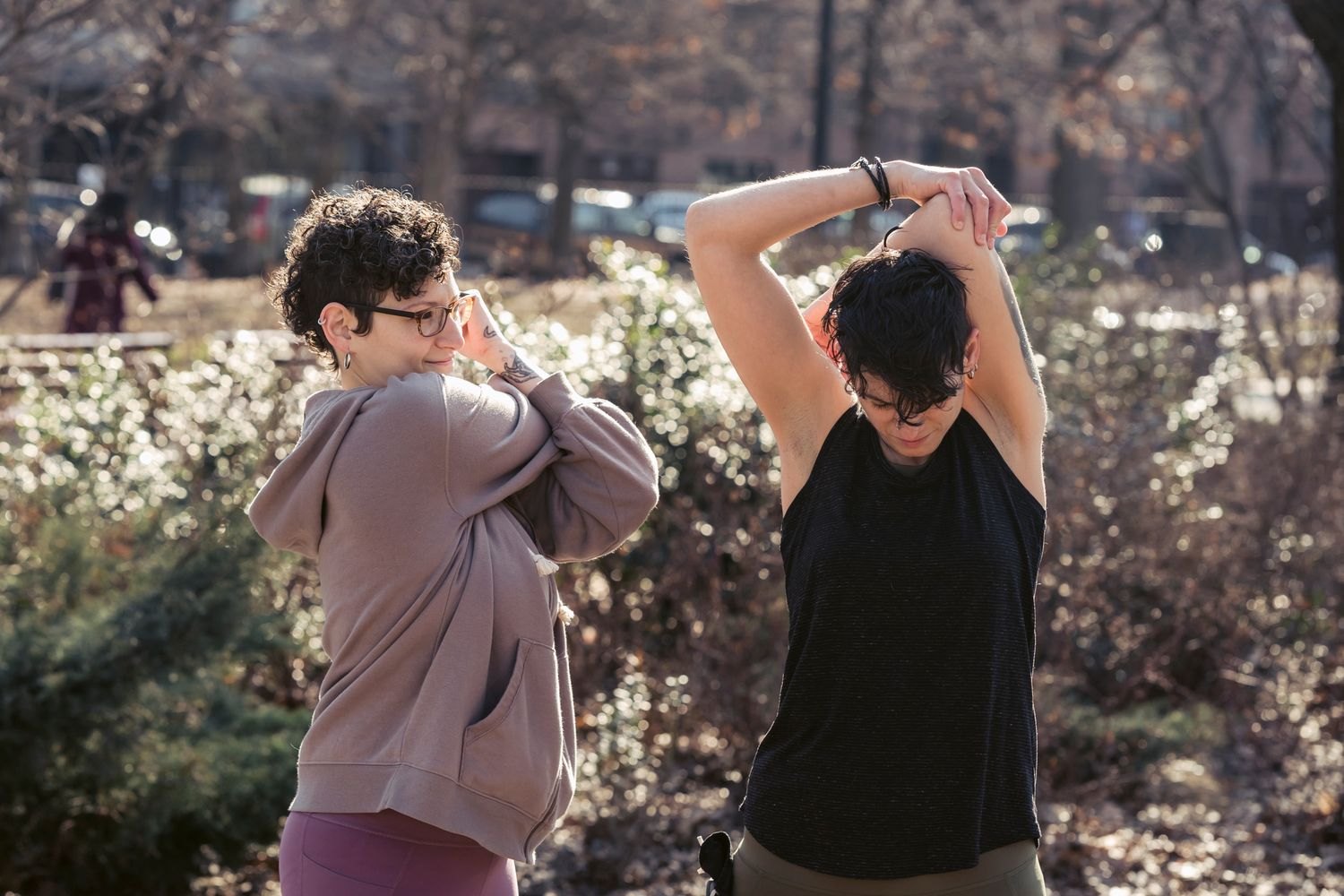
Shoulder circles are convenient because they need no equipment and take little space. They can be a comfortable way to begin moving after sitting. Their convenience does not make them a complete preparation for every upper-body exercise.
A row asks you to pull against resistance. A press asks you to control a load in a different direction. Both involve a particular grip, starting position and return path. Circling the arms does not check those details.
Begin with easy general movement, then bring the warm-up closer to the planned exercise. Before a row, use a light handle or dumbbell to rehearse the pull. Before a push-up, practice an easier version at a suitable height. The aim is to experience the actual task at a manageable demand.
Keep the circles comfortable
If you choose arm or shoulder circles, start small and increase only within a comfortable range. There is no need to make the largest possible loop or force the arms behind the body. A painful arc is a reason to stop and reconsider, not a section to sweep through faster.
Pay attention to the rest of the setup too. A press may feel awkward because the bench angle or hand position is unsuitable, not because you failed to circle the shoulders long enough. A row may need a better support position. Preparation includes arranging equipment as well as moving joints.
Use the rehearsal to decide whether the planned exercise fits today. A familiar light movement should give you information without exhausting the muscles. If you need repeated hard sets to feel ready, the working plan may need adjusting or the movement may need individual review.
Do not measure the warm-up by the number of different drills you include. A brief, relevant sequence can be more useful than a long collection of unrelated movements. Keep the elements that help you approach the exercise, and leave out those that serve no clear purpose.
For someone with an injury, recent surgery or a health condition affecting exercise, follow the preparation recommended by their treating professional. A generic shoulder routine cannot account for those circumstances. For ordinary training, circles can remain a small beginning, followed by the more specific rehearsal that the session actually needs.