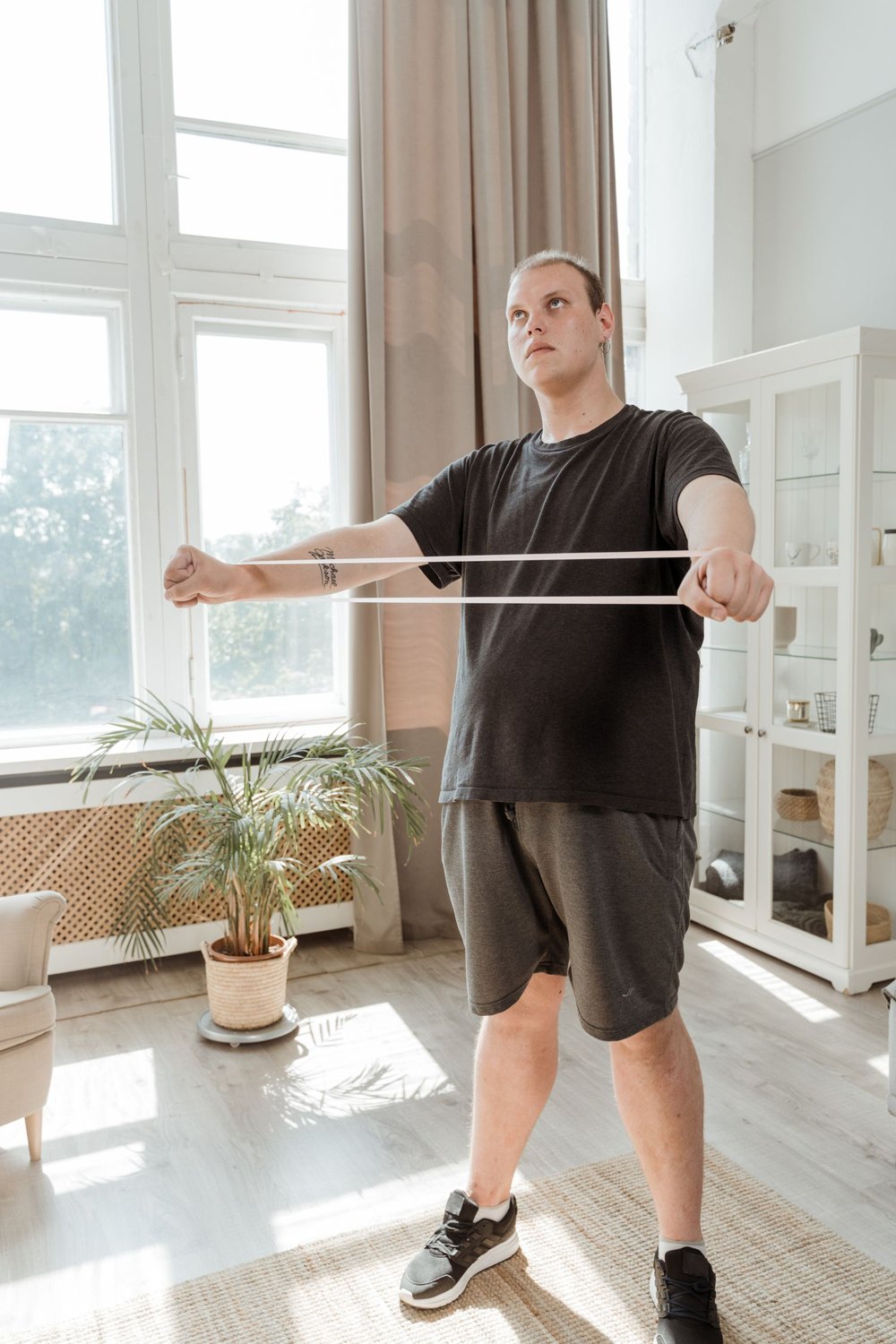
Not every band exercise needs a door or wall attachment. Some use the body as part of the setup, such as standing on a long band for a curl. The important distinction is that the exercise must be designed for that arrangement. Removing an anchor from an anchored exercise does not automatically create a usable alternative.
Use the manufacturer's exercise instructions to identify options for your band type. A continuous loop and a flat strip with free ends behave differently. Check permitted stretching and how the band should contact footwear or hands. If you cannot arrange it without excessive tension at the start, it may be too short or too resistant for that movement.
Inspect the band before use and remove anything from its path that could cut or abrade it. When standing on a band, use the specified placement on a suitable, nonslip surface. Do not rely on the edge of a shoe barely pinning it down. A band that slips from underfoot can recoil quickly.
Start with one uncomplicated movement
Rehearse the setup at low tension. Check that you can hold the band securely, move through the intended comfortable range and return without losing control. Avoid wrapping it tightly around your hand to compensate for an uncertain grip, and do not invent knots or extensions unless the product instructions allow them.
The resistance usually changes through the movement as the band stretches. That can make the final part feel much harder than the beginning. Choose a setup that remains manageable at the demanding point instead of judging it only by the first few inches.
Keep your face away from a likely recoil path and follow any product-specific protection guidance. If an exercise requires you to pull a stretched band toward your head without a clearly approved arrangement, choose a different movement or obtain qualified instruction.
Place the band down without tension when changing exercises. It is easy to turn a simple transition into a tangle by trying to step out while still pulling. Slow changes are particularly useful in a small room where the ends might catch furniture.
You may discover that a no-anchor session offers fewer pulling options than the routine you had planned. Accept that limit. A smaller selection of well-understood exercises is more useful than attaching the band to an improvised object just to complete a list.