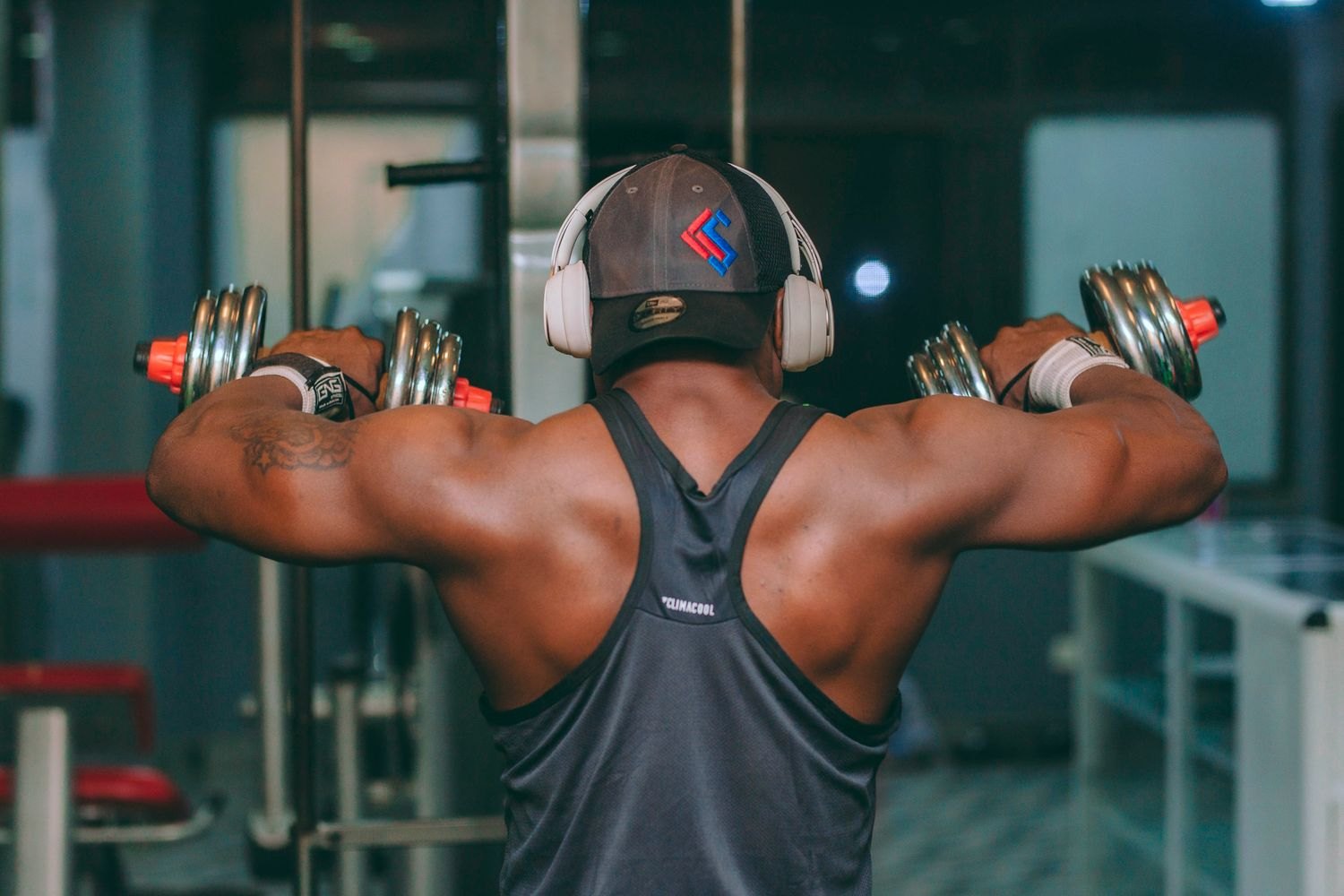
Ceiling fans are easy to forget until a dumbbell approaches one. Low beams, hanging lights and sloped ceilings create similar problems. Before an overhead press, check the entire path of your hands and the weights, not just the space around your shoulders.
Stand or sit in the intended position and raise empty hands through a comfortable range. Include the extra height of the implement when judging clearance. If the room is too low, choose another location or a different exercise. Ducking the head or leaning sideways around an obstacle changes the movement while leaving the hazard in place.
Find room in the setup too
A seated press needs secure seating and sufficient backrest clearance; a standing version needs stable footing and room to put weights down. Test both the start and finish. If lifting the dumbbells into position is already near your limit, the planned pressing weight is not suitable for an independent beginner session.
Use light resistance while learning, and let the arms follow a comfortable path. Do not force a grip or elbow angle simply because someone else's demonstration looks neat. Your torso should not have to arch dramatically to create the appearance of a full overhead reach. A qualified trainer can help distinguish a useful adjustment from an exercise that is poorly matched to you.
The highest possible position is not automatically the best target. Choose a range you can control without pain, then lower with attention. If an overhead movement remains uncomfortable, a different pushing exercise may be more appropriate. You do not have to prove that you can press above your head before training the upper body in other ways.
A rack, bench or machine can simplify some aspects of the task, but it does not remove the need to learn its settings. Machine handles may follow a fixed path that suits one person better than another. Ask for a demonstration and try the lightest useful resistance before deciding that the equipment fits.
When a set becomes difficult, keep the space check in mind. A step backward, a sudden lean or a widened weight path can bring you nearer an obstacle that was safely distant at the start. Finish before that sort of improvisation becomes necessary.
For home training, mark the suitable area by its actual surroundings rather than relying on memory. “Beside the window, clear of the fan” is a useful setup note. It solves a concrete problem that a heavier pair of weights never will.